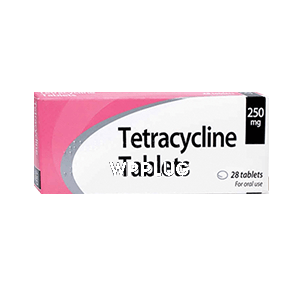
| Product dosage: 250mg | |||
|---|---|---|---|
| Package (num) | Per pill | Price | Buy |
| 180 | $0.32 | $57.07 (0%) | 🛒 Add to cart |
| 360 | $0.29
Best per pill | $114.14 $104.13 (9%) | 🛒 Add to cart |
| Product dosage: 500mg | |||
|---|---|---|---|
| Package (num) | Per pill | Price | Buy |
| 60 | $0.72 | $43.05 (0%) | 🛒 Add to cart |
| 90 | $0.63 | $64.58 $57.07 (12%) | 🛒 Add to cart |
| 120 | $0.58 | $86.11 $70.09 (19%) | 🛒 Add to cart |
| 180 | $0.55 | $129.16 $98.12 (24%) | 🛒 Add to cart |
| 270 | $0.52 | $193.74 $139.17 (28%) | 🛒 Add to cart |
| 360 | $0.51
Best per pill | $258.32 $182.23 (29%) | 🛒 Add to cart |
Similar products

More info:
Tetracycline: Effective Bacterial Infection Treatment - Evidence-Based Review
Tetracycline is a foundational broad-spectrum antibiotic in the tetracycline class, originally derived from Streptomyces bacteria but now largely produced synthetically. It’s a bacteriostatic agent, meaning it inhibits bacterial protein synthesis rather than outright killing bacteria, which gives it a distinct place in antimicrobial therapy. We still reach for it regularly in dermatology for acne vulgaris, in infectious disease for rickettsial infections like Rocky Mountain spotted fever, and as an alternative for various community-acquired infections when penicillin allergies are present.
accutane
Accutane, the brand name for isotretinoin, represents one of the most potent and controversial systemic therapies for severe, recalcitrant nodular acne. As a synthetic vitamin A derivative (retinoid), its introduction revolutionized dermatology, offering potential remission for conditions where conventional antibiotics and topical agents failed. However, its significant teratogenic risk and side effect profile demand rigorous clinical oversight, making it a treatment reserved for carefully selected patients under strict monitoring protocols. This monograph provides a comprehensive, evidence-based review of Accutane, detailing its pharmacology, therapeutic applications, safety considerations, and clinical evidence to guide both healthcare professionals and informed patients.
biaxin
Biaxin, known generically as clarithromycin, is a semi-synthetic macrolide antibiotic derived from erythromycin. It’s primarily prescribed for bacterial infections affecting the respiratory tract, skin, and other systems. What makes Biaxin particularly valuable in clinical practice is its enhanced acid stability and broader spectrum compared to earlier macrolides, though we’ve learned its real-world application requires careful patient selection. Key Components and Bioavailability Biaxin The active pharmaceutical ingredient is clarithromycin, formulated as 250mg or 500mg tablets, extended-release tablets (500mg), or oral suspension (125mg/5mL or 250mg/5mL).
calcium carbonate
Calcium carbonate represents one of the most fundamental yet frequently misunderstood compounds in clinical practice. When patients ask me about calcium supplements, they’re often surprised to learn that the chalky white tablets they’ve been taking for years have a complex pharmacological profile that extends far beyond basic bone health. The reality is that calcium carbonate sits at the intersection of gastroenterology, nephrology, and preventive medicine, with applications ranging from routine supplementation to emergency medical interventions.
Cefaclor: Effective Bacterial Infection Treatment - Evidence-Based Review
Cefaclor is a second-generation cephalosporin antibiotic belonging to the beta-lactam class, structurally characterized by a chlorine atom at position 3 of the cephem nucleus. This oral antibacterial agent demonstrates enhanced stability against certain beta-lactamases compared to first-generation agents, particularly those produced by Haemophilus influenzae and Moraxella catarrhalis. Its development in the late 1970s addressed the growing need for broader-spectrum oral antibiotics that could effectively manage outpatient respiratory and urinary tract infections, especially in pediatric populations where compliance with injectable regimens posed significant challenges.
cenmox
Cefuroxime axetil, commonly known by its trade name Cenmox, represents a second-generation cephalosporin antibiotic with a rather interesting ester prodrug formulation that significantly enhances its oral bioavailability compared to earlier cephalosporins. What makes this molecule particularly valuable in clinical practice is its expanded spectrum of activity against both gram-positive and gram-negative organisms, bridging that gap between narrow-spectrum and broad-spectrum antibiotics in a way that’s clinically practical for outpatient management. I remember when we first started using this agent back in the late 90s - there was some skepticism among our infectious disease team about whether it offered enough advantage over amoxicillin-clavulanate to justify the cost difference.
chloramphenicol
Let me walk you through what we’ve learned about chloramphenicol over the years - this isn’t the polished monograph you’d find in a textbook, but the real clinical picture that emerges after decades of use. When I first encountered chloramphenicol during my infectious disease rotation back in the late 90s, it was already considered a “last resort” antibiotic, but the reality is more nuanced than that simple categorization suggests. Chloramphenicol represents one of those fascinating cases in antimicrobial therapy where a drug’s reputation often precedes its actual clinical utility.
chloromycetin
Chloramphenicol, marketed historically as Chloromycetin, remains one of the most fascinating and clinically challenging antibiotics in our armamentarium. I still remember the first time I encountered it during my infectious disease rotation at Massachusetts General - the attending physician handling the vial with this strange mixture of reverence and caution that immediately signaled this wasn’t just another antibiotic. What began as a miracle drug in the late 1940s has evolved into a carefully restricted therapeutic agent that we reserve for specific, life-threatening infections where nothing else will suffice.
Cystone: Comprehensive Kidney and Urinary Tract Support - Evidence-Based Review
Cystone represents one of those interesting botanical formulations that somehow manages to maintain clinical relevance despite the overwhelming shift toward synthetic pharmaceuticals in urology. I first encountered this preparation during my nephrology rotation in the late 1990s, when our department head—a traditionally trained physician with surprising openness to evidence-based botanicals—would routinely recommend it for patients with recurrent calcium oxalate crystals who weren’t quite surgical candidates yet. 1. Introduction: What is Cystone?