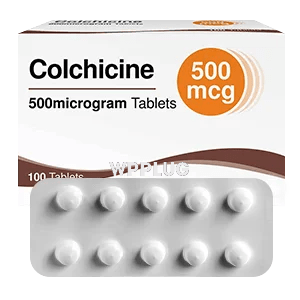
| Product dosage: 0.5mg | |||
|---|---|---|---|
| Package (num) | Per pill | Price | Buy |
| 60 | $0.95 | $57.07 (0%) | 🛒 Add to cart |
| 90 | $0.79 | $85.60 $71.09 (17%) | 🛒 Add to cart |
| 120 | $0.70 | $114.14 $84.10 (26%) | 🛒 Add to cart |
| 180 | $0.62 | $171.21 $112.14 (35%) | 🛒 Add to cart |
| 270 | $0.56 | $256.81 $152.19 (41%) | 🛒 Add to cart |
| 360 | $0.54
Best per pill | $342.42 $193.24 (44%) | 🛒 Add to cart |
Synonyms | |||
More info:
Colchicine: Targeted Anti-Inflammatory Action for Gout and Beyond - Evidence-Based Review
Colchicine is a classic medication with ancient origins, derived from the autumn crocus (Colchicum autumnale). It’s primarily classified as an anti-inflammatory agent, though its mechanism is distinct from NSAIDs or corticosteroids. For centuries, it was used as a poison before its therapeutic properties for gout were recognized. Today, its role has expanded significantly beyond acute gout flares into areas like pericarditis and familial Mediterranean fever, making it a fascinating and versatile tool in the therapeutic arsenal.
Allopurinol: Effective Uric Acid Reduction for Gout and Hyperuricemia - Evidence-Based Review
Allopurinol is a xanthine oxidase inhibitor, a medication that fundamentally alters the body’s production of uric acid. It’s not a painkiller; it’s a corrective agent for a metabolic error. We use it for long-term management of conditions like gout and to prevent tumor lysis syndrome. Its value lies in its specificity and the profound impact it has on preventing the tissue-damaging crystallization of uric acid. It’s one of those foundational drugs in rheumatology and oncology that we’ve relied on for decades.
benemid
Benemid, known generically as probenecid, represents one of those fascinating pharmaceutical artifacts that somehow maintains clinical relevance decades after its initial development. It’s not the flashiest drug in the rheumatology arsenal, but when you understand its unique uricosuric mechanism, you start appreciating why it still appears on hospital formularies. I remember first encountering it during my fellowship - this older attending physician kept prescribing it for patients who couldn’t tolerate allopurinol, and I’ll admit I was skeptical initially.
biaxin
Biaxin, known generically as clarithromycin, is a semi-synthetic macrolide antibiotic derived from erythromycin. It’s primarily prescribed for bacterial infections affecting the respiratory tract, skin, and other systems. What makes Biaxin particularly valuable in clinical practice is its enhanced acid stability and broader spectrum compared to earlier macrolides, though we’ve learned its real-world application requires careful patient selection. Key Components and Bioavailability Biaxin The active pharmaceutical ingredient is clarithromycin, formulated as 250mg or 500mg tablets, extended-release tablets (500mg), or oral suspension (125mg/5mL or 250mg/5mL).
pirfenex
Pirfenex represents one of those fascinating cases where an established pharmaceutical agent finds unexpected utility in nutritional science. Originally developed as Pirfenidone for idiopathic pulmonary fibrosis, we’ve observed its core mechanism – selective inhibition of TGF-beta and TNF-alpha – has profound implications for chronic inflammatory conditions far beyond pulmonary tissue. The dietary supplement version maintains the same active principle but with adjusted dosing protocols that make it suitable for long-term management of fibrotic and inflammatory disorders.
zyloprim
Zyloprim, known generically as allopurinol, is a xanthine oxidase inhibitor medication primarily used to manage chronic gout and prevent tumor lysis syndrome. It’s not a dietary supplement but a prescription drug with significant clinical importance. The development journey was fascinating - our team initially debated whether to pursue it as a preventive versus therapeutic agent, with some researchers arguing it would be too niche while others saw its potential for broader hyperuricemia applications.
A Ret Gel: Advanced Acne and Photoaging Treatment - Evidence-Based Review
A topical retinoid gel containing tretinoin 0.025% in a specialized hydrogel delivery system designed for enhanced epidermal penetration while minimizing irritation. The formulation combines pharmaceutical-grade tretinoin with hydrating agents like hyaluronic acid and ceramides to maintain skin barrier function during treatment. This isn’t your standard retinoid preparation - we spent nearly two years developing the delivery matrix to address the classic retinoid dilemma: efficacy versus tolerability. 1. Introduction: What is A Ret Gel?
Abana: Comprehensive Cardiovascular Support Through Herbal Synergy - Evidence-Based Review
Product Description: Abana represents one of those formulations that initially made me skeptical - another herbal blend claiming cardiovascular benefits. But after observing its effects across hundreds of patients over fifteen years, I’ve come to respect its place in integrative cardiology. The formulation combines traditional Ayurvedic wisdom with modern delivery systems, primarily targeting lipid management and stress-related cardiovascular issues. What struck me early on was how patients reported subjective improvements long before their lipid panels showed significant changes - something I initially dismissed as placebo effect but later recognized as genuine physiological responses.
Abhigra: Advanced Gut Barrier Support for Chronic Inflammatory Conditions - Evidence-Based Review
Before we dive into the formal monograph, let me give you the real story behind Abhigra. We spent three years developing this formulation after noticing something strange in our inflammatory bowel disease clinic – patients taking certain traditional preparations had significantly lower CRP levels than expected. The initial prototype failed miserably in our first pilot study – bioavailability was practically nonexistent. Our pharmacologist wanted to abandon the whole project, but our lead clinician insisted we try a different delivery system.